Luxor, the West Bank: The Valley of the Kings, Hatshepsut and Medinet Habu
The west bank at Luxor is where Thebes buried its dead. The kings were laid in a dry valley behind the hills, out of sight of the river, and the temples built for their memory stand in a line where the fields meet the desert. Every Aeterna voyage crosses to this side.
ON THE STANDARD ITINERARY · ALL VOYAGES
The Valley of the Kings

For nearly five hundred years, from the Eighteenth Dynasty to the Twentieth, the kings of Egypt were buried here in tombs cut into the rock. Sixty-five tombs and chambers are known. Above them stands the peak of al-Qurn, which the Egyptians called simply the Peak.
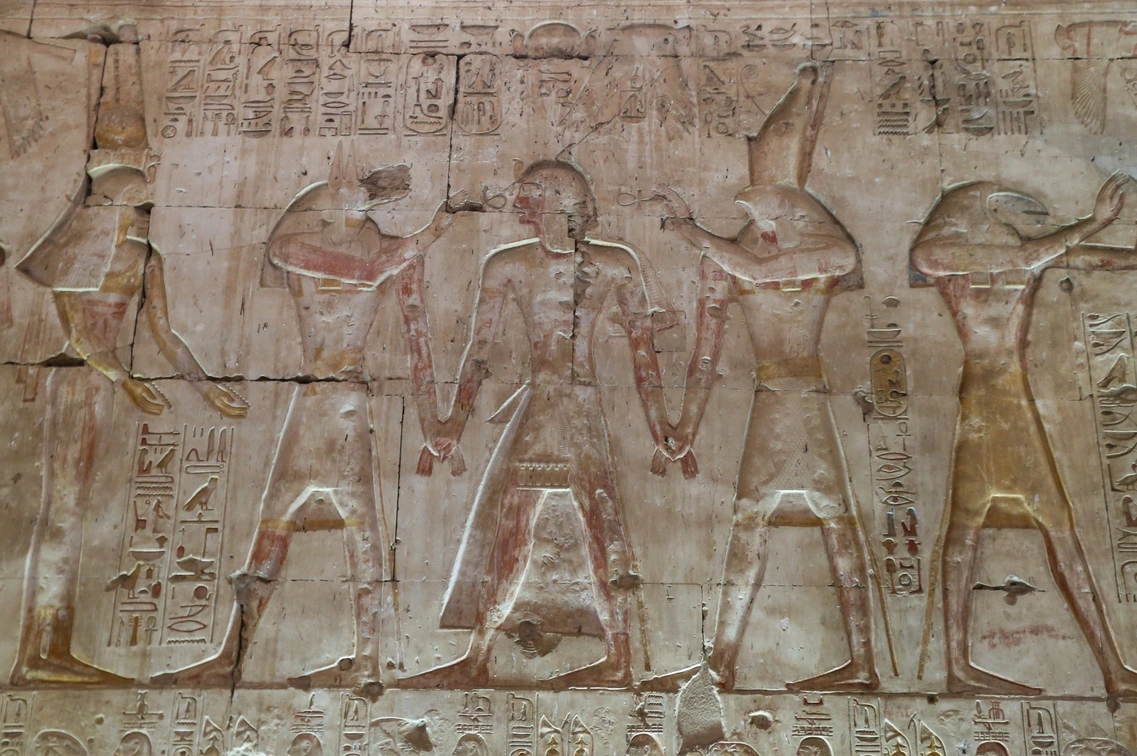
The paintings on the walls count the hours. The earlier tombs follow the Amduat, a text that takes the sun god through the twelve hours of the night until he rises again in the east. From the reign of Horemheb the tombs use the Book of Gates, in which the night is divided by twelve gates.

The tomb of Tutankhamun was found here on 4 November 1922, when the excavators led by Howard Carter uncovered the first step of its staircase. Only some of the tombs are open at any one time, and the selection changes.
ON THE STANDARD ITINERARY · ALL VOYAGES
The Temple of Hatshepsut

Hatshepsut ruled Egypt as king in the fifteenth century BC, and this is the temple she built for her own cult and for the god Amun. It rises in three terraces against the cliffs of Deir el-Bahari and was under construction from the seventh year of her reign to the twentieth. Its long axis points across the river at Karnak.
The reliefs on the middle terrace record an expedition she sent to the land of Punt, with its ships, its cargo and the goods brought back to Thebes. About twenty years after her death, under Thutmose III, her names and images were cut away across the temple. A Polish team has been putting it back together since 1961.
ON THE STANDARD ITINERARY · ALL VOYAGES
The Colossi of Memnon

The two seated figures are Amenhotep III. They stood at the gate of his mortuary temple, the largest in Thebes, of which almost nothing else is left. Each is about eighteen metres high with its base, and the quartzite they are made of was brought 675 kilometres from quarries near modern Cairo.
An earthquake in 27 BC broke the northern statue, and after that it was heard to make a sound, usually at dawn. The Greeks decided it was Memnon, son of the dawn goddess. Travellers came for two centuries to hear it and cut their names into the stone. There are 107 of these inscriptions in Greek and Latin, among them verses recording a visit by the emperor Hadrian in AD 130. The last reliable report of the sound dates from 196.
“Prefects, Consuls, Emperors, and Empresses, came ‘to hear Memnon,’ as the phrase then ran.”
AMELIA B. EDWARDS, A THOUSAND MILES UP THE NILE, 1877
ON THE STANDARD ITINERARY · 4-NIGHT AND 7-NIGHT VOYAGES
Medinet Habu

Medinet Habu is the mortuary temple of Ramesses III, who reigned from about 1186 to 1155 BC, and it is the best preserved of its kind at Thebes. Its outer walls carry the reliefs of his wars against the Sea Peoples, including a battle fought among ships in the Delta. Inside, under the roofed colonnades, much of the original colour is still on the stone.
People went on living within its walls long after the temple closed. By the ninth century AD it was a Coptic town called Jeme.
BY PRIVATE ARRANGEMENT
Further on the West Bank

Three further places can be arranged for private charters and tailor-made journeys.
Deir el-Medina is the village of the craftsmen who cut and painted the royal tombs. Thousands of their notes and accounts survive on flakes of limestone, and they record what may be the first strike in history, around 1170 BC, when the men stopped work over late rations.
The Ramesseum is the mortuary temple of Ramesses II, the Ozymandias of Shelley’s poem. Its fallen colossus once stood some nineteen metres high.
The tomb of Nefertari in the Valley of the Queens was found in 1904. The restoration of its paintings began in 1986, and entry has been restricted since then to protect them.