Aswan: Philae, the High Dam and the Unfinished Obelisk
Aswan is where the Nile changes. North of here the river runs wide and slow between fields. At Aswan it breaks around islands of granite, the First Cataract, which for most of ancient history marked the southern frontier of Egypt. Every Aeterna voyage calls here and stays the night.
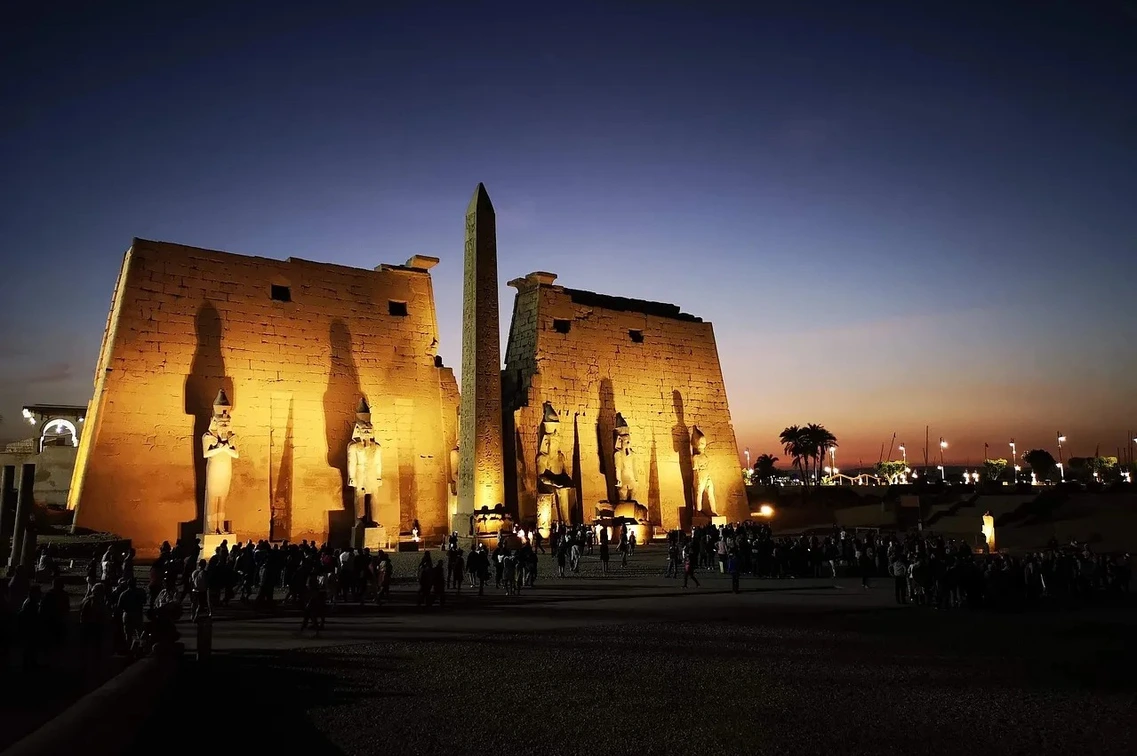
The stone under the town was cut for monuments all along the river. The obelisk that still stands before Luxor Temple came from these quarries and was carried north by barge.
ON THE STANDARD ITINERARY · ALL VOYAGES
Philae Temple

You come to Philae the way people always have, by water. The boat leaves a jetty south of the old dam and, within a few minutes, the temple of Isis is ahead of you, low on its island, with the river on every side.
“Seen from the level of a small boat, the island, with its palms, its colonnades, its pylons, seems to rise out of the river like a mirage.”
AMELIA B. EDWARDS, A THOUSAND MILES UP THE NILE, 1877
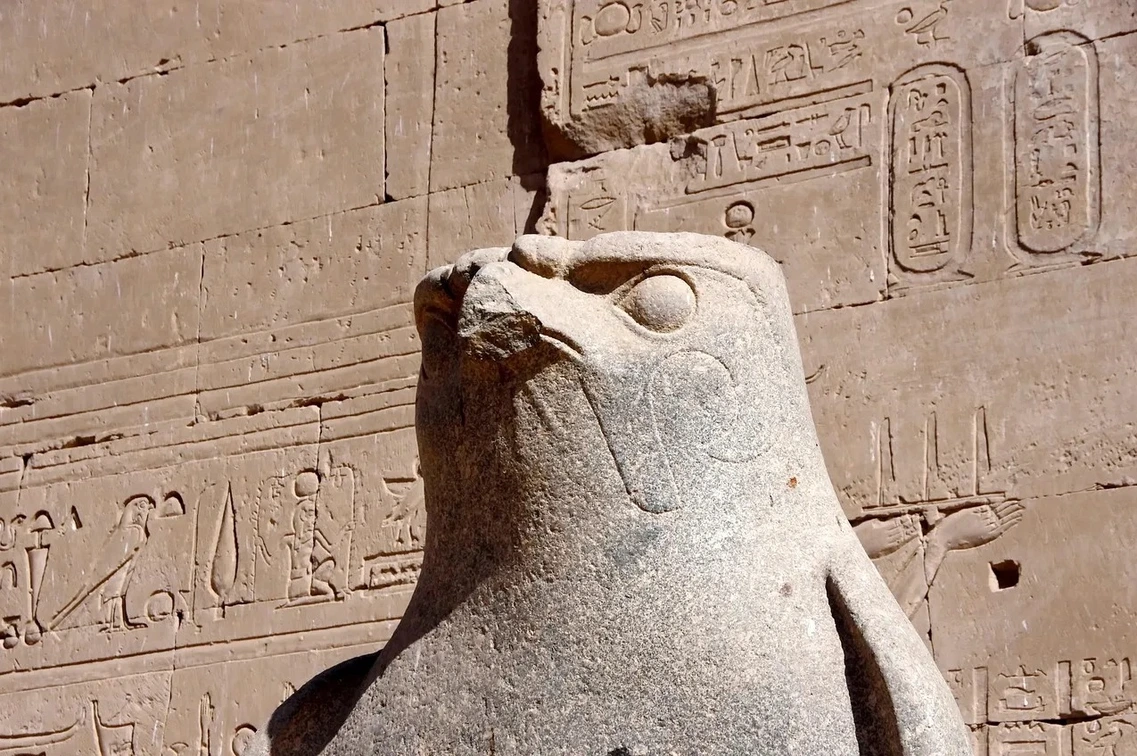
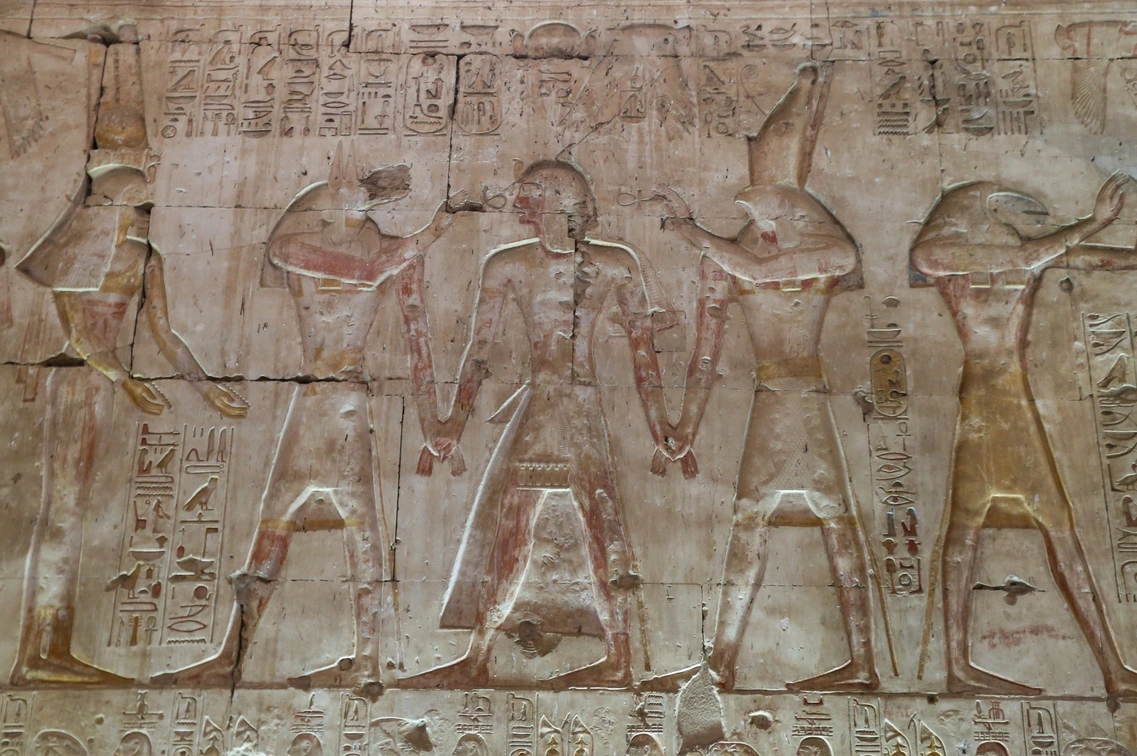
It was the last place in Egypt where the old gods were still served. Priests kept the rites of Isis here into the 530s, and on Hadrian’s Gate one of them, Esmet-Akhom, carved the last hieroglyphs anyone is known to have written. He dated them 24 August, AD 394. The text says it was made “for all time and eternity”.
The island itself is new. After the first Aswan Dam was finished in 1902 the temple stood in water for most of each year, and in the 1970s it was taken apart, some 40,000 pieces, and rebuilt on higher ground 500 metres away. It reopened in 1980.
Before you leave, walk down to Trajan’s Kiosk at the water’s edge. It has fourteen columns and no roof, and its carving was never finished.

ON THE STANDARD ITINERARY · 4-NIGHT AND 7-NIGHT VOYAGES
The High Dam

In the ancient Egyptian calendar the year began with the flood, and the first of its three seasons was named for it. The High Dam, built between 1960 and 1970, brought that to an end. The annual flood has not come since.
The dam is 3,830 metres long and 111 metres high, and the lake behind it reaches some 480 kilometres to the south. As the water rose it threatened the temples of Nubia, and between 1960 and 1980 a campaign led by UNESCO moved 22 monuments to higher ground, Philae and Abu Simbel among them. From the crest you see the lake on one side and the old river on the other.
ON THE STANDARD ITINERARY · 7-NIGHT VOYAGES
The Unfinished Obelisk

In a granite quarry at the edge of the town lies the largest obelisk the Egyptians are known to have cut. It is 41.75 metres long and would have weighed about 1,168 tonnes. It never left the ground. Cracks opened in the stone and the work stopped. It is usually dated to the reign of Hatshepsut, in the fifteenth century BC, though the attribution is not certain.
Because it was abandoned where it lay, you can see how it was made. The trenches along its sides were pounded out by hand with balls of harder stone, and their marks are still in the granite.
ON THE STANDARD ITINERARY · 4-NIGHT AND 7-NIGHT VOYAGES
By Felucca Among the Islands

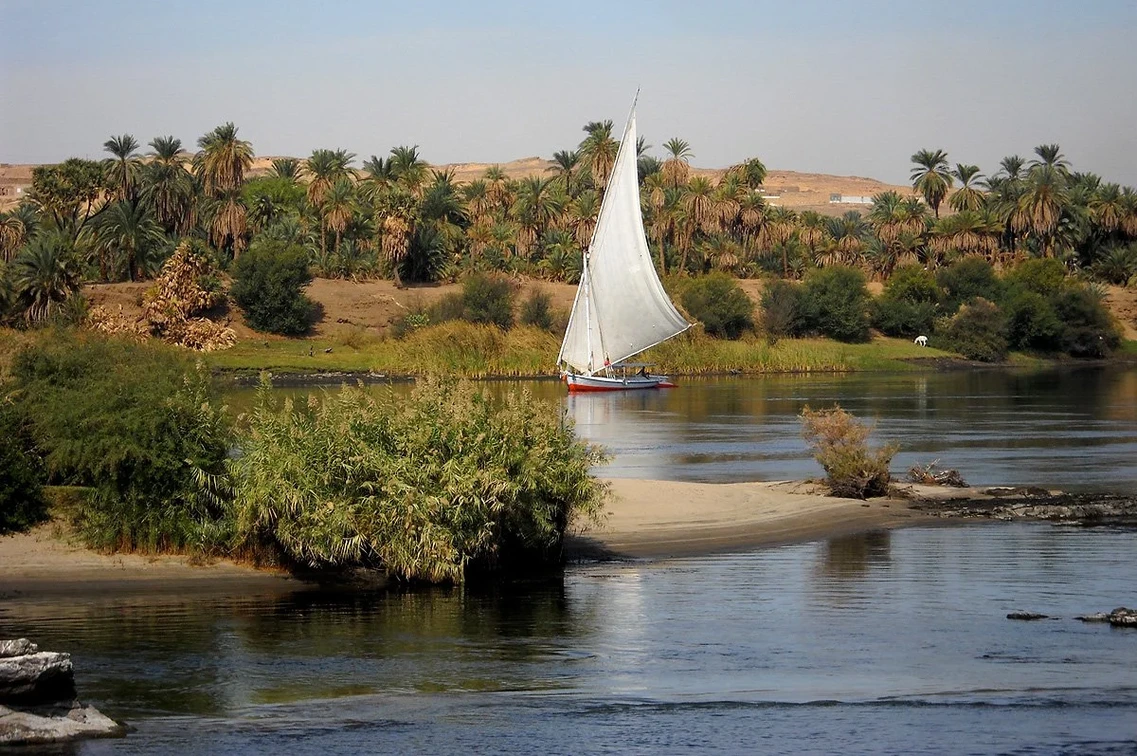
A felucca is the wooden sailing boat of this stretch of the Nile, with a single tall sail. In the afternoon one takes you out among the islands.
Kitchener’s Island was given to Lord Kitchener while he was British Consul-General in Egypt, between 1911 and 1914. He planted it with trees, many of them brought from India, and it is now Aswan’s botanical garden.

On the hill above the west bank stands the mausoleum of Aga Khan III, who died in 1957. It was built between 1956 and 1960 on the model of a Fatimid mosque in Cairo. The interior is closed to visitors, but a red rose is still laid on the tomb every day, a custom begun by his wife, the Begum Om Habibeh.
OPTIONAL EXCURSION · 7-NIGHT VOYAGES
Abu Simbel

Abu Simbel lies about 300 kilometres south of Aswan by road, close to the Sudanese border. Ramesses II had its two temples cut into the cliff between about 1264 and 1244 BC, and the larger was laid out so that, on two mornings a year, the rising sun reaches the statues at the back of the sanctuary.
Between 1964 and 1968 both temples were cut into blocks and rebuilt 65 metres higher, clear of the rising lake, and the alignment was kept. On 22 February and 22 October the light still reaches the sanctuary.
BY PRIVATE ARRANGEMENT
Further Into Aswan

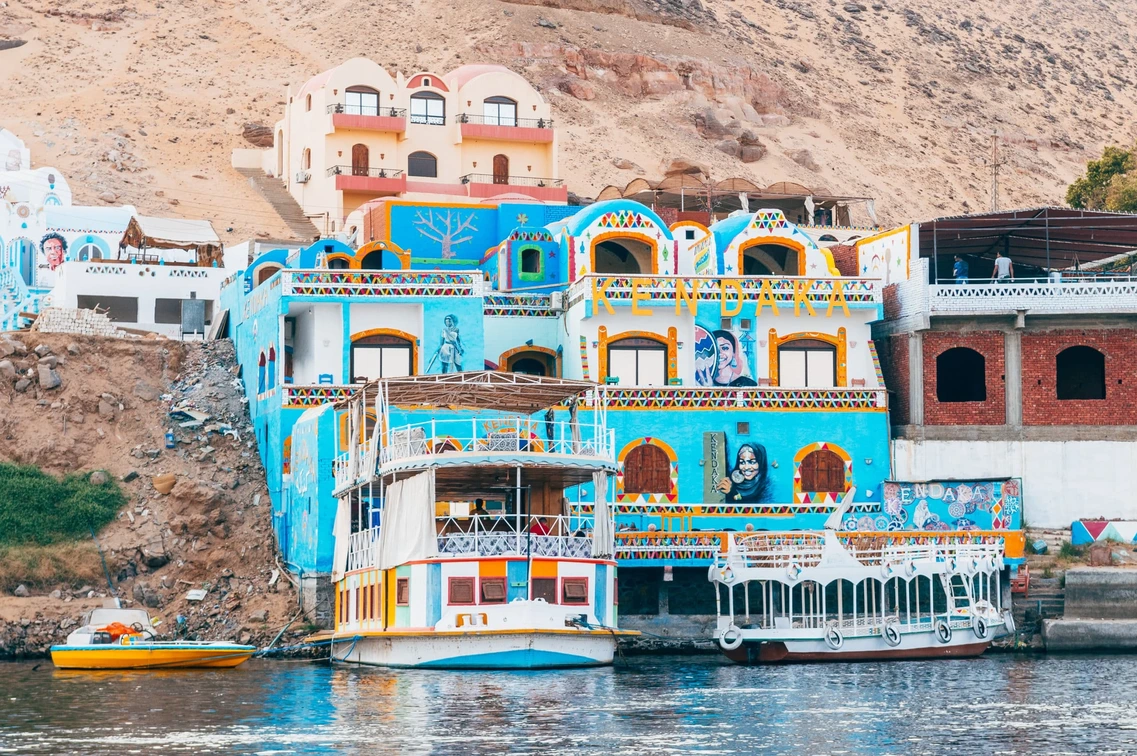
Two further places can be arranged for private charters and tailor-made journeys.
The Nubian Museum opened in 1997, after the UNESCO campaign, and is given to the history and culture of Nubia. Its building received the Aga Khan Award for Architecture in 2001.
Elephantine Island, opposite the town, was the frontier post of ancient Egypt. It holds the ruins of the temple of Khnum, a small museum, and a Nilometer whose ninety steps were still used to read the height of the flood in the nineteenth century.