The Colour of a Nubian House
I want to tell you about a doorway.
It is in Gharb Soheil, on the west bank at Aswan, about halfway up the sandy lane that climbs from the water. The wall around it is whitewashed. The doorframe is painted a blue so saturated it looks wet, and above the door there are three plates set into the plaster, and a row of hand painted triangles in ochre and green running along the top of the wall.
A woman I have known for years lives behind it. Her mother painted that frame. Her daughter repaints it now, the same colour, because that is the family's blue.
I have taken hundreds of people past that door and I have never once got there without somebody stopping.
First, The Thing You Should Know Before You Arrive
Nubia is not a region of Egypt in the way people assume. It is a country in the older sense: its own languages, its own architecture, its own music, its own history that runs alongside pharaonic Egypt rather than under it.
Nubian kings ruled Egypt as the 25th Dynasty. There were Nubian kingdoms at Kerma and Meroe with their own pyramids, more pyramids in Sudan than in all of Egypt. This is not a footnote to the story you have been reading on the temple walls. It is a parallel civilisation on the same river.
And then, in the twentieth century, most of it went underwater.
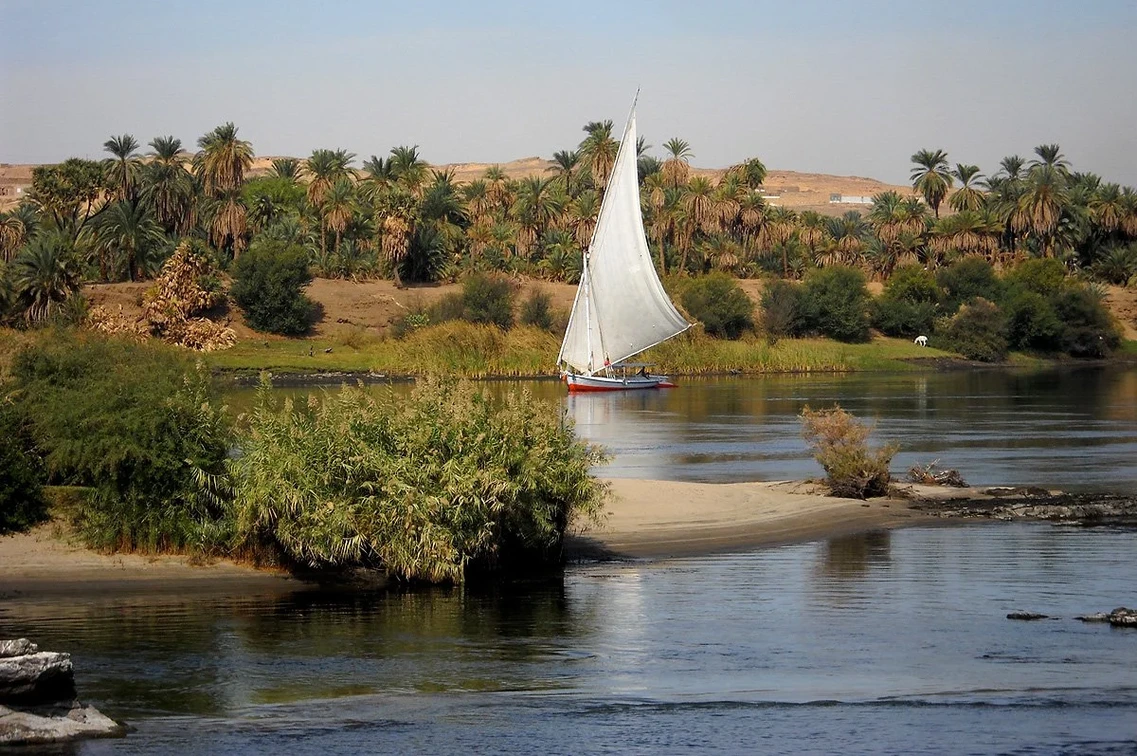
The dams did it in stages, and the High Dam finished it in the 1960s. Around fifty thousand Nubians in Egypt were moved off their land. Villages that had stood on the river for centuries are now under Lake Nasser. People were resettled in new towns near Kom Ombo, in concrete housing built by planners who did not ask them anything about how a Nubian house works.
I say this early because otherwise the colour reads as decoration. It is not. When you have lost the actual ground, the way you build and paint becomes the thing you carry.

Now the palette.
Whitewash as the ground, then cobalt and turquoise for the frames, and ochre, saffron, terracotta and a strong grass green for the patterns. Geometry: triangles, zigzags, diamonds, sun discs, palm shapes. Often plates or bowls pressed into the plaster around the door, catching the light.
Some of the motifs are very old, older than the pharaohs, and belong entirely to Nubian visual tradition. Some are personal. A house might carry marks recording a pilgrimage to Mecca, or a wedding, or simply what the family finds beautiful.
Every household paints its own. There is no village committee. And yet walk the whole lane and it holds together completely, because everybody is working from the same inherited vocabulary in the same light.
That is a lesson I keep thinking about. Total individual freedom, complete collective coherence, no rulebook. Just a shared sense of what belongs here.
I will say one honest thing. Some of the houses closest to the boat landing have been repainted brighter and more often since visitors started coming, and there are shops now where there were homes. That is real and it is fair to notice. Walk further up the hill. Five minutes past the last stall the colour gets older and softer and the doors are open because people actually live there.

You will be invited in. This is going to happen, and it is not staged.
You take your shoes off. You sit on a low bench along the wall of the courtyard, on cushions, with your back to cool plaster. Somebody brings karkade, hibiscus tea, which in summer comes iced and dark red and sharp, and in winter comes hot. There will be dates. There may be a small crocodile in a tank in the corner, which is a genuine old Nubian tradition and startles absolutely everybody, and no, you do not have to touch it.
The floor is sand. Clean, swept, fine sand, indoors, and it is wonderful under bare feet.
Somebody will start drumming on a tar, a wide frame drum, and somebody will sing, and the language will not be Arabic. Nobiin and Kenzi are Nubian languages and they are unrelated to Arabic entirely. They are spoken but rarely written, which means they live in exactly this: in songs, at home, between generations.
Take the tea. Sit down properly instead of hovering. Ask the woman of the house about the pattern above her door, and mean it, and you will get a real answer.

The palm frond baskets are the thing.
They are woven from date palm fronds, sometimes with henna wood, in tight coils with colour worked into the pattern, and they are made by women, at home, in a skill handed from mother to daughter. A good one takes days. They are strong enough to use for the rest of your life and they cost very little, which is a whole conversation in itself.
There is also hand painted Nubian pottery in that cobalt and terracotta palette, and beadwork, and woven mats.
Buy from the house you sat in, if you can. Ask who made it. If nobody can tell you, it is probably not from here.

Late afternoon, walking back down towards the boat, the light goes gold and low across the sand lane and the blue doorframes go almost violet.
There are children playing. Somebody is cooking. A radio somewhere.
And I think, most times: this is a culture that lost its land inside living memory and answered by building a house you cannot look away from.
Not a museum. Not a preserved village. A working street, where the great grandchildren of displaced people paint their doors the family blue every few years, because that is what you do.
The temples upriver were built to survive. This survived without being built to.
When you travel, do you spend your time with the monuments or with the people who live around them, and has one ever changed your mind about the other?