The Temple That Spent Half A Century Underwater
The first thing you should know about Philae is that you cannot walk to it.
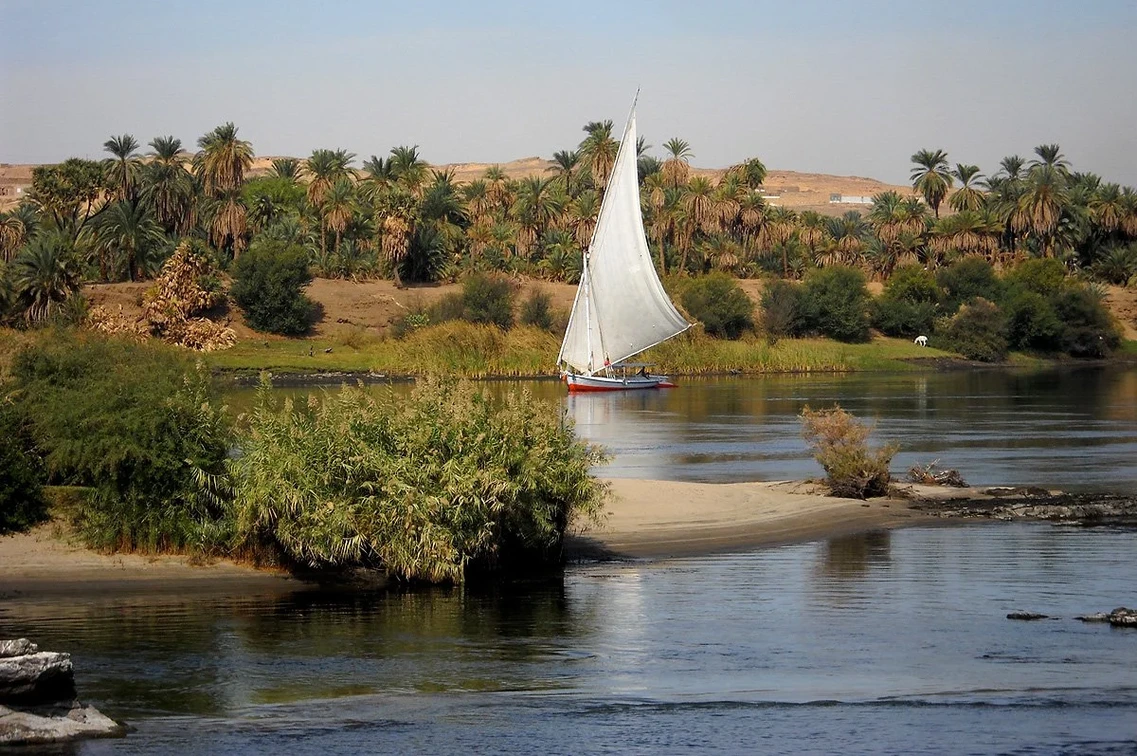
You get in a small boat at a jetty south of Aswan, and a man in a long white galabeya casts off without much ceremony, and for about ten minutes there is nothing to do but sit. Granite islands slide past, black and rounded, polished by water. The engine is loud. Nobody talks much.
Then the boat comes around the last rock and the temple is simply there, sitting on the island with its feet in the river.
I have made this crossing since I was a boy, and I still turn my head at the same moment.
A River That Swallowed A Temple
Philae was built for Isis, and it was the last place in Egypt where the old religion was still practised. There are priests recorded here into the sixth century of our era, long after the rest of the country had turned to Christianity. The final hieroglyphic inscription ever carved in Egypt is on this island, dated to 394 CE.
Then, in 1902, the British finished the first Aswan dam and the water came up.
For most of each year after that, Philae was underwater. The columns stood in the reservoir with their capitals showing. The reliefs were submerged for months at a time, and every year the water rose and fell across the same stone.
Victorian travellers used to row out over it. There are photographs and paintings from the 1900s of tourists in boats drifting between the tops of the columns, looking down through green water at the roof of a temple. Pierre Loti wrote about it. So did others. It became a strange, sad attraction: the sunken sanctuary.
The stone survived better than anyone expected, because the silt that settled on the reliefs actually protected them. But the colour went. Whatever paint remained after sixteen centuries was washed off in thirty years.

Then They Decided To Move It
When Egypt began planning the High Dam in the 1960s, the calculation changed completely. Philae would no longer be seasonally flooded. It would be permanently drowned, and worse, it would sit between two dams in constantly moving water that would grind the sandstone away.
So a decision was made that still astonishes me: they would take the temple apart and carry it uphill.
This was part of the wider international campaign that ran from 1960 to 1980 and saved more than twenty monuments across Nubia, Abu Simbel among them. Philae's turn came between 1972 and 1980.
First they built a coffer dam, a steel wall in a ring around the island, and pumped the water out. Imagine that: an island being emptied.
Then they cleaned the silt off every surface, photographed and numbered every stone, and cut the buildings apart into more than forty thousand blocks. The blocks were moved five hundred metres to Agilkia, a neighbouring island that stood higher. Engineers had already reshaped Agilkia's granite to match the profile of the original island, so the temple would sit in the landscape the way it always had.
Then they put it back together. It reopened in March 1981.
I tell people this before we land, because otherwise they will walk through the colonnade and never know. There are no seams to find. No visible joins. You are looking at a building that was taken to pieces within living memory and reassembled by hand, and it looks like it has never been touched.

What The Water Left Behind
Walk into the first courtyard and look at the columns about waist height.
There is a line. A soft horizontal band where the stone changes texture and colour, running through the whole complex at the same level. Below it the sandstone is smoother, slightly darker, worn in a way that has nothing to do with wind.
That is the waterline. Seventy years of a river, written on a building.
I like showing this more than almost anything else on the island, because it collapses the distance. The temple is Ptolemaic, more than two thousand years old, and here is a mark on it left by something that happened in your grandmother's lifetime.
The reliefs on the outer walls have another layer of history on them. Many of the faces of Isis and Osiris were chiselled away by early Christians who used the temple as a church; you can still see crosses cut into the walls of the hypostyle hall. Then Napoleon's men left their names. Then Victorian visitors left theirs.
Nothing here was left alone. Everything was used, defaced, adapted, drowned, salvaged. That is not damage to me. That is the biography.

Go At Night, And Then Go Again In The Morning
There is a sound and light show after dark, and I know exactly how that sounds. The narration is theatrical, the music is dated, and I recommend it without hesitation anyway.
Because you cross the water in darkness. The boat has no lights to speak of, the granite islands are just shapes, and then the colonnade comes up lit from below and floating. For about ninety seconds before anyone starts speaking, it is the most beautiful thing in Aswan.
But go back in the morning if you can. Early, before nine. The light comes across the water almost horizontally and gets right inside the hypostyle hall, and the carved capitals throw shadows that move while you watch. There are usually more birds than people. Pied kingfishers work the shallows at the edge of the island, hovering and dropping.
Sit on the steps at the eastern side, the ones that go down into the river, and just stay there for a while. Those steps used to be the landing. Pilgrims arrived by boat here for eight hundred years, tied up, and climbed.
The Other Stone That Measures The River
If Philae moves you, ask to see the nilometer on Elephantine Island, back at Aswan.
It is a staircase. Ninety steps going down into the river through a narrow stone corridor, with marks cut into the wall at intervals.
That is all it is, and it ran the country.
Every year, priests here measured how high the flood came. Elephantine was upstream of everything, so this was the first reading Egypt got. That number told you what the harvest would be, how much grain the state could expect, and therefore what the tax rate would be that year.
A good flood meant a full year. A low flood meant hunger. Too high meant villages washed out.
Egypt's entire economy, for thousands of years, hung on a number read off a wall in a dark stairwell in Aswan.
I go down those steps and put my hand flat on the wall at the height of a good year, and it is above my head.
Two Ways Of Holding On
Here is what stays with me about Aswan.
At Philae, we picked up a temple and carried it out of the water because we could not bear to lose it. At Elephantine, our ancestors cut marks into a wall because they could not control the water and needed to know what it was going to do to them.
Both are the same instinct, separated by four thousand years. Standing in front of a river and refusing to be passive about it.
The Nile has been the subject of that argument for as long as anybody has lived beside it. Sometimes the river wins. Sometimes it does not.
Have you ever visited a place that was saved, physically moved or rebuilt, and did knowing that change how it felt to stand there?