The Hands That Are Still Working
There is a moment in almost every alabaster workshop on the Luxor west bank when the man carving stops, picks up the piece he has been shaping, and holds it in front of a bare bulb.
The stone goes translucent. You can see his fingers through it, dark, moving on the far side.
It gets the same reaction every single time, and he knows it does, and he does it anyway with the timing of somebody who has done it ten thousand times and still likes the trick.
The Stone That Lets Light Through
Egyptian alabaster is not really alabaster. It is calcite, banded in cream and honey and pale amber, and it comes out of the hills behind the Valley of the Kings, from quarries that have been worked since the Old Kingdom.
The ancient Egyptians made canopic jars from it, and offering tables, and lamps. There is an alabaster boat in the Tutankhamun collection so thin that a candle inside it lights the whole hull.
The workshops today are family businesses, and the good ones will show you the whole process without being asked. A block is roughed out with a hammer and chisel, then hollowed with a bow drill, an actual bow drill, a stick spun in a loop of cord, which is the same tool you will see men using in the wall paintings at Deir el-Medina an hour up the road.
Then rasped. Then sanded, by hand, through progressively finer grits, wet, for a long time. Then polished with a stone.
A serious piece takes days. The dust is everywhere; it goes white on their eyebrows and forearms and turns the workshop floor into something like a beach.
Here is the part I always tell people, because it saves money and disappointment: hold two pieces up to the light, one handmade and one machine made, and you will know in a second. The hand carved one has a slightly uneven wall thickness, so the light through it is uneven, warmer in some places. It glows in a way that is not uniform. The machine made one is perfectly even and dead.
Ask to see the workshop, not the showroom. If there is no dust on the floor, you are in a shop.

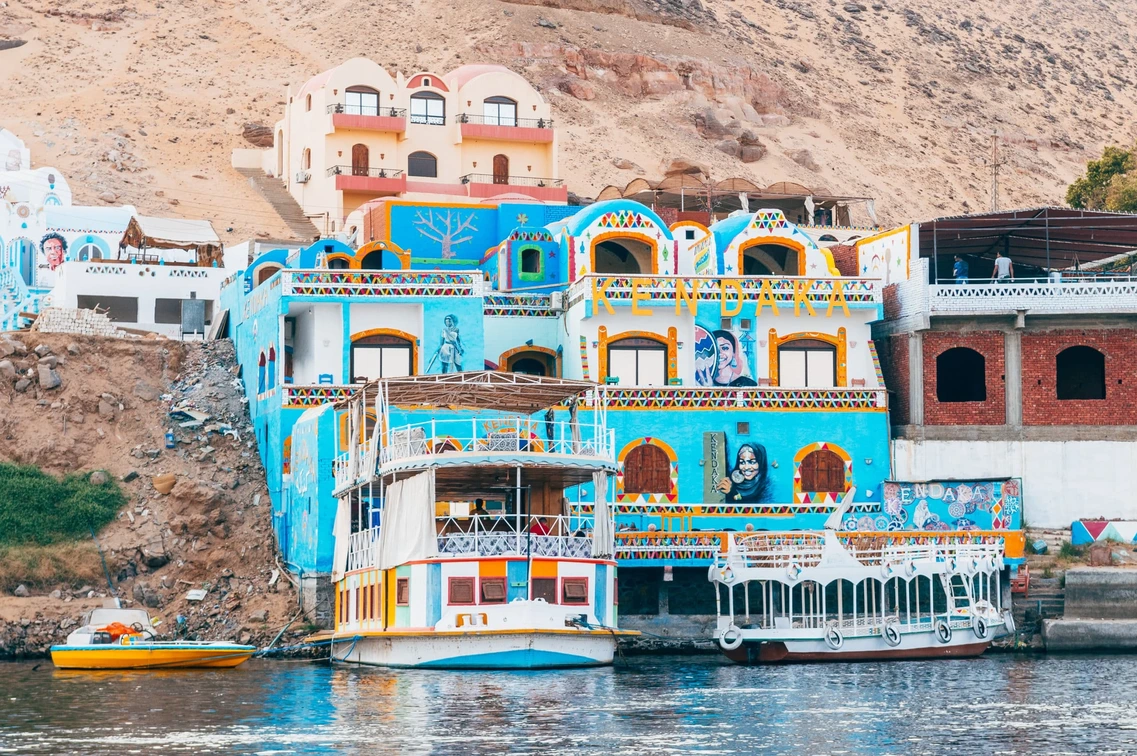
Downriver in Nubian Aswan, the craft is fibre.
Date palm fronds, split, soaked, and coiled into baskets and mats and lids, worked in tight spirals with colour running through the pattern. Sometimes henna wood. Sometimes wool worked in for the deeper reds.
This is made at home, by women, in the courtyard or the front room, in the hours between other work, and taught from mother to daughter without anything written down. A large piece takes days of steady work.
I have sat and watched it for an hour and I still cannot see how the coil is locked. The hands move faster than the explanation.
What I find striking is that this is not decorative work that happens to be useful. It is the household's containers. Bread lids, storage baskets, floor mats, the tray the tea comes on. The beauty is in something you use every day until it wears out and then you make another one.
There is an idea in there that our own design culture keeps rediscovering, renaming, and selling back to itself.

The Oldest Material Of All
Now look at the buildings.
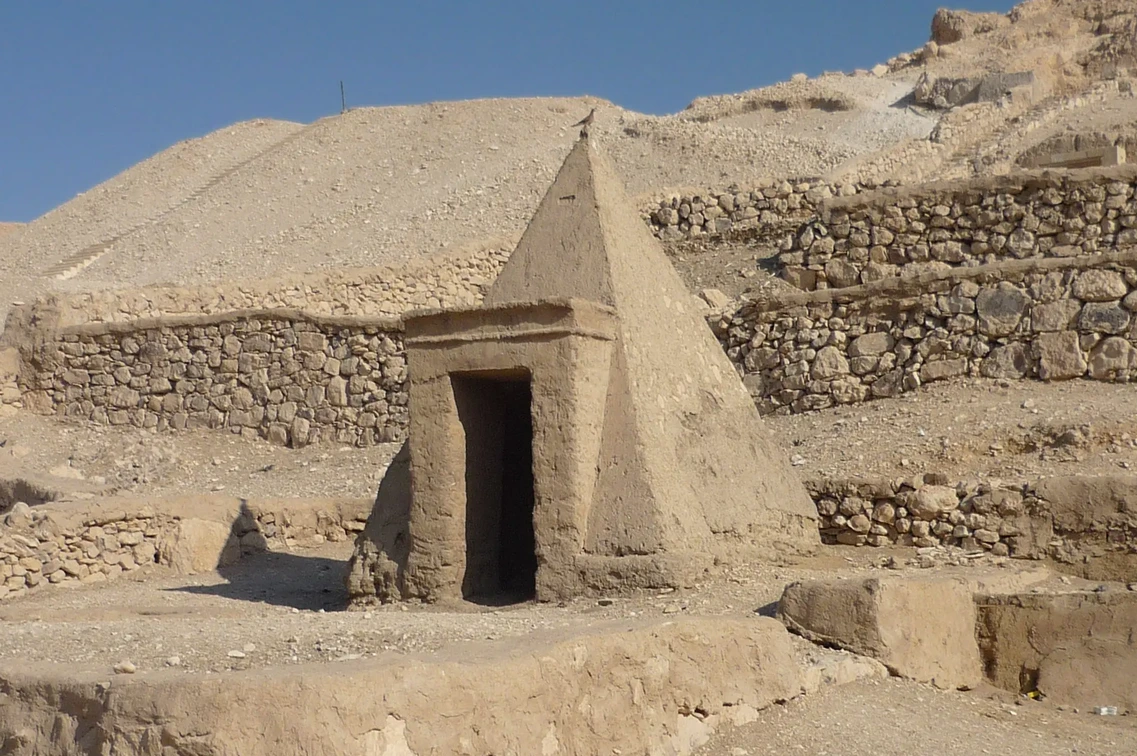
Mud brick. Nile silt mixed with straw and sand, pressed into wooden moulds, dried in the sun for a week. No firing, no fuel. When the building eventually falls down it goes back into the ground it came from.
The vaults and domes I described in the Nubian villages are built from it, without timber formwork, using a technique that has been on this river for three thousand years and more.
For most of the twentieth century this was treated as the material of poverty, and concrete was progress. Villages that had been cool and quiet were rebuilt in concrete boxes with flat roofs that turn into ovens by noon.
Then Hassan Fathy went the other way.

Fathy is on my mind constantly on this stretch of river, and not only because of a suite named after him.
He was born in 1900, trained as a modern architect, and in 1941 he travelled to a village near Aswan and watched Nubian masons throwing vaults by hand with no wood and no engineering drawings. It changed the direction of his working life.
His argument was straightforward and unfashionable. Egypt did not need to import expensive imported materials to house its people. It needed to look at what the poorest villages had already worked out over millennia: earth, shade, thermal mass, courtyards, domes, and the labour of the family that would live there.
In 1945 he was commissioned to build New Gourna near Luxor, a whole village to rehouse families who had been living on top of the Theban tombs. He designed it in mud brick, with vaults and domes and a market and a theatre, and he tried to build it with the villagers rather than for them.
It did not go smoothly. Many of the families did not want to move, for reasons that were entirely their own and had a lot to do with what was under their old houses. Parts of New Gourna were never finished, and much of what was built has since been lost.
But the buildings worked. Interiors measured up to ten degrees cooler than the shade outside, with no machine of any kind involved.
He wrote a book about it, Architecture for the Poor, and it went around the world, and architects in Latin America and West Africa and India read it and changed what they were doing.
You can visit what remains of New Gourna. It is quiet and a bit sad and I think it is one of the most important places on the west bank. A mosque, a few houses, the shell of the theatre.

What Craft Actually Means Here
There is a habit of talking about traditional crafts as though they are being kept alive, which always sounds to me like a hospital word.
Some of it is fragile, and honestly some crafts here are going. Handloom weaving has thinned out badly. Some of the older metalwork has almost stopped. Cheap imports fill the stalls, and a young man can earn more driving than carving.
But the parts that survive are not surviving as heritage. They survive because they are the best answer available to a practical problem. The palm basket is still the right container. The mud vault is still the coolest roof. The alabaster lamp still does the thing with the light.
And what runs through all of it is the same instinct you see in the tomb paintings at Deir el-Medina: material worked by hand until it does something more than it needs to.
The men who carved royal tombs went home and painted their own ceilings. The woman weaving a bread lid puts a pattern in it that nobody will see once the bread is on it. Nobody asked for the extra.
That impulse is four thousand years old on this river and it has not stopped.

Go where it is made, not where it is sold. Ask who made it and watch whether the answer comes easily.
Buy fewer things and better ones. One good alabaster bowl that glows unevenly, one palm basket you will actually put fruit in, one piece of Nubian pottery in that cobalt.
And ask about the maker's name. In my experience people are pleased to give it, and it changes the object permanently. It stops being a souvenir the moment it has a person attached to it.
I have a small alabaster cup at home, uneven, slightly off round, made by a man named Sayed on the west bank. It is not the finest piece I have ever seen. I know exactly whose hands it came out of, and that is why it is on the shelf.
Do you bring things home from your travels, and what makes an object worth the space in the suitcase for you?