Edfu and Esna: The Temple of Horus and the Lock
For centuries the houses of Edfu stood on top of a temple. Sand and river silt had buried it twelve metres deep, until only the tops of its gateway towers showed above the ground. When Auguste Mariette began to dig it out in 1860, the building underneath turned out to be almost whole. Further down the river, at Esna, the Nile is held back by a barrage and the ship is taken through a lock.
ON THE STANDARD ITINERARY · ALL VOYAGES
The Temple of Horus at Edfu

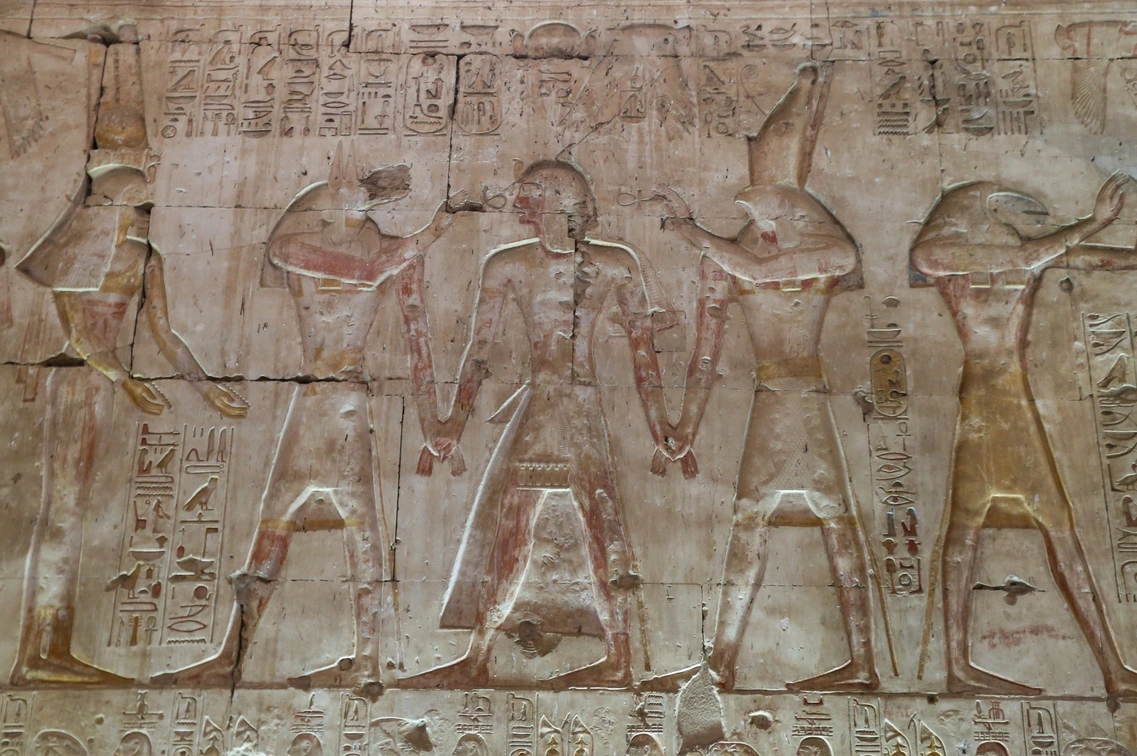
The temple of Horus at Edfu was begun on 23 August 237 BC and finished in 57 BC. It is nearly intact. The gateway, the walls and the roof are all still in place, so this is the temple where you can walk from the entrance to the sanctuary as its priests did, out of the daylight and into the dark.
“Take it for what it is — a Ptolemaic structure preserved in all its integrity of strength and finish — it is certainly the finest extant Temple in Egypt.”
AMELIA B. EDWARDS, A THOUSAND MILES UP THE NILE, 1877

The inscriptions on the walls record how the temple was built and what it was for. In the sanctuary stands a stone shrine made for Nectanebo II, which is more than a century older than the building around it. Before the gateway, look for the falcon of Horus wearing the double crown of Egypt.

ON THE SHIP’S ROUTE · ALL VOYAGES
The Esna Lock
Esna is about 55 kilometres south of Luxor. A barrage was built across the Nile here in 1906 and a second in the 1990s, and ships pass them through a lock. The passage can take some time. From the deck you watch the water rise or fall against the wall of the chamber until the gates open.
BY PRIVATE ARRANGEMENT
The Temple of Khnum at Esna

Only the columned hall of this temple is left. It was added in Roman times, probably under the emperor Claudius, and it stands in the middle of the town, in a pit well below the level of the streets around it. The roof rests on twenty-four columns, and no two of their capitals are alike.
Among its texts is one of the last hieroglyphic inscriptions ever carved, from the reign of the emperor Decius, AD 249 to 251. In recent years the walls and ceiling have been cleaned, and the colours beneath have come back.